AR-TUR are known for their dedication to deepening architectural and urban knowledge, and their work has helped us to bring the history and significance of our project to life in a truly special way. Their research and documentation efforts not only inspire thought, but are also a source of inspiration for many, including ourselves.
We are proud to share their work and acknowledge the hard work and passion invested in their publication. This is a beautiful example of the power of collaboration and knowledge sharing.
AR-TUR was able to count on the valuable cooperation of the Flemish Architecture Institute (VAI) for the realization of this book. Their expertise, dedication, and rich archival work have played an essential role in documenting and making accessible the architectural heritage that is central to this publication.
The history of the architectural archive in Flanders has a strong foundation in the Architecture Archive Province of Antwerp (APA), which for many years played a crucial role in collecting and preserving architectural archives of leading Antwerp designers. With the transition to the Flemish Architecture Institute, this operation was not only anchored, but also further expanded, giving the architectural archive a broad Flemish support base.
Thanks to their efforts, the heritage of generations of architects remains preserved, studied and accessible to both researchers and the general public. Their contribution to this book is therefore invaluable.
Sincere thanks to the VAI team for their knowledge, enthusiasm and the care with which they preserve and share architectural history.
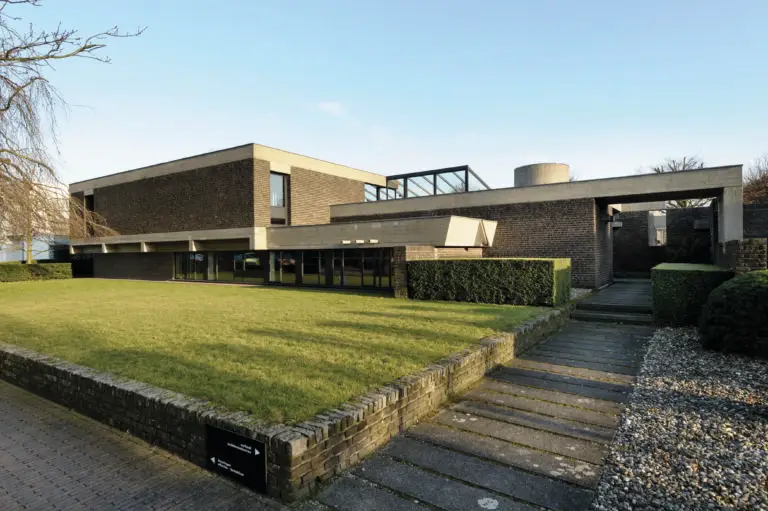
The Turnhout School refers to a group of architects who were active in and around Turnhout in the 1960s and 1970s. This group, including names such as Carli Vanhout, Paul Schellekens, Paul Neefs, Lou Jansen and Rudi Schiltz, combined innovative architecture with a strong connection with the region. Inspired by modernist masters such as Le Corbusier, Arne Jacobsen and Mies van der Rohe, they managed to develop a unique architectural style that was both progressive and locally rooted.
In the so-called ‘golden sixties’, these architects shaped an architecture that prioritised quality of life and functionality, with a focus on aesthetics and innovation. Important projects such as the Park District, the De Warande Cultural Centre and the Saint Victor School illustrate this vision. These buildings show an evolution from modernist principles to a more contextual and human approach, in which the relationship between architect, client and environment was crucial.
Although they did not enter into formal collaboration, the architects shared a similar view of contemporary architecture. The term ‘Turnhout School’ therefore refers more to a shared mentality and vision than to a strictly organised movement. Their work reflects a quest for beauty and harmony, aimed at improving the living environment and integrating architecture into a broader social and cosmic framework.
The influence of the Turnhout School extended beyond Turnhout itself. Architects such as Vanhout & Schellekens and Paul Neefs drew inspiration from international architecture and brought this knowledge back to the Campine region, where they translated it into a regionally bound but universally comprehensible style. These architects often worked on both private homes and large public projects, convincing local clients of their modern approach.
The Turnhout School marks an important chapter in Belgian architectural history. Often regarded as the last generation of late modernists, this group of architects combined technical innovation with a personal and human approach to architecture. Their work continues to inspire to this day as an example of how modernist principles can be successfully aligned with local identity and personal expression.