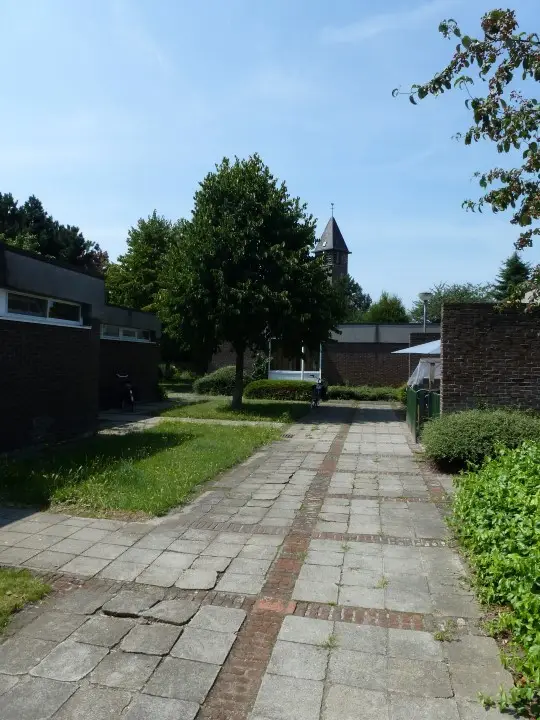
A Brutalist ensemble of ten senior residences and a clubhouse designed by Carli Vanhout in collaboration with Paul Schellekens and originally featuring landscaping by Henri (Rik) Carlier (not preserved).
Construction History and Context
The senior residences and clubhouse Den Horst were commissioned by the Turnhout Housing Association and designed by Carli Vanhout, probably in collaboration with Paul Schellekens, with whom he would officially associate in 1965. They were constructed between 1962 and 1964 on a plot south of Steenweg op Oosthoven, right next to the Parish Church of the Divine Child Jesus (Groeningeplein, now Goedendagstraat). The small senior housing complex was built as the final phase of a larger neighborhood of single-family homes that had been constructed a year earlier on Hogestraat and Goedendagstraat (33 owner-occupied homes and eight rental homes). This was also designed by Carli Vanhout and Paul Schellekens, albeit in a much less innovative style (not included in the demarcation).
The De Horst senior housing complex is characteristic of the transition to the pronounced Brutalist style that Vanhout’s work underwent in the 1960s, influenced by his collaboration with Schellekens. From 1963, Vanhout and Schellekens developed their own version of Brutalism, primarily inspired by Le Corbusier’s late work such as Les Maisons Jaoul (1951). Characteristic of Vanhout and Schellekens’ work is their pursuit of a total design concept, where homes, landscaping and outdoor furnishing (including benches) form an inseparable unity. As with other projects, they collaborated with landscape architect Henri (Rik) Carlier for Den Horst. However, in 2015, the outdoor layout was significantly altered, resulting in a partial loss of the complex’s heritage value.
Description and Characterisation
The Den Horst senior housing complex consists of ten brick, single-storey bungalows with a flat roof, and a clubhouse (also one storey under a flat roof); two sets of four staggered bungalows (sawtooth pattern) and two detached bungalows, grouped around the centrally positioned clubhouse. The bungalows are all of the same type and positioned with identical orientation (living room with terrace facing south). According to the construction plans, the bungalows comprise a bay with entrance and service areas (storage, kitchen and bathroom) and a bay with living room and bedroom. The placement of windows in the façade follows from the internal layout: the living room opens with a large window (reaching to the ceiling) to the outdoor space, the bedroom features a narrow vertical window, and the service areas have high-level ribbon windows. The original dark-colored wooden frames have been replaced everywhere with white PVC.
Of particular note is the layout of both bungalows and outdoor spaces on an orthogonal grid. The high density and the staggered placement of bungalows at an angle to the street creates a sequence of enclosed squares (redesigned in 2015), which are also defined by side walls extending into the outdoor space (especially at the clubhouse). The original outdoor layout included concrete tiles, lawns, groups of shrubs and trees as accents (largely disappeared).
The architectural design of the bungalows is distinctly Brutalist, with characteristic elements including the use of dark exposed brick, deeply recessed windows, walls without coping stones and without soldier courses, and rough-formed exposed concrete for the continuous roof edges. The projecting concrete blocks, inspired by Le Corbusier’s late architecture, serve specific functions: as light fixtures (on garden walls), as spouts, as benches (on the façade), as planters (next to the front door). Both building volumes and details are block-like, creating a cubist impression.
Evaluation
In 2015, the overall value of the senior housing complex was severely compromised by the redesign of the outdoor space, which disregards the materiality of the homes and the original organisation of the outdoor space. However, the senior residences have retained their architectural and urban planning value, which was highly innovative for its time.
The owner-occupied and rental homes on Hogestraat and Goedendagstraat were not assigned heritage value as the unity of the façades has been insufficiently preserved due to individual modifications of window frames.