The home and studio of Carli Vanhout, designed in collaboration with Paul Schellekens during his final year of studies, marks the beginning of their characteristic brutalism. The complex, serving as both home and studio, represents the powerful manifesto behind their young firm and demonstrates an exceptional sensitivity to space, material, and rhythm.
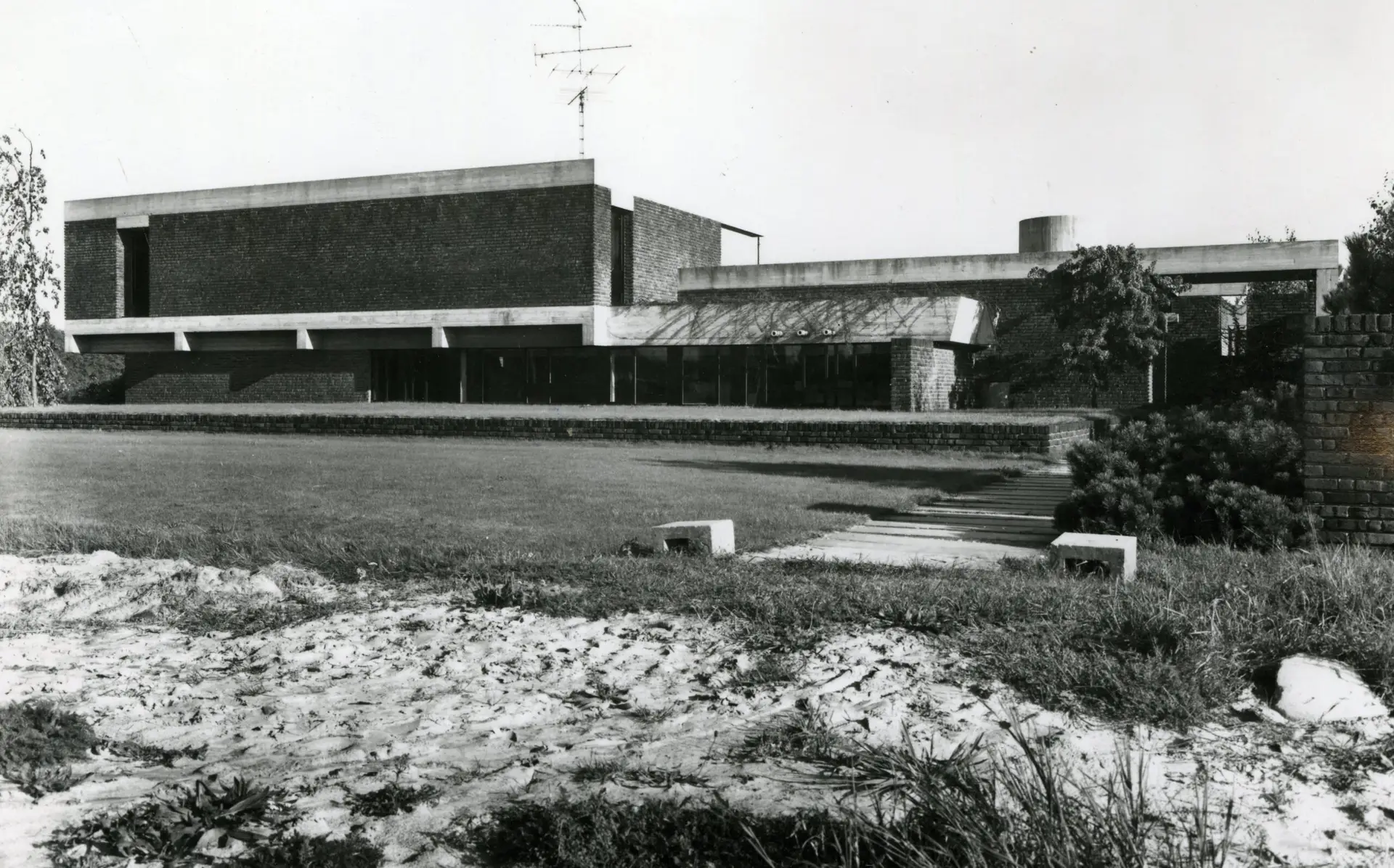
The site is remarkable: at the front it sits along Turnhout’s new ring road while at the rear it borders the open landscape around the Aa river. The building actively responds to this context. On the street side, the robust block serves as a buffer against traffic, with semi-sunken garages and a drawing studio, and office spaces above. At the rear, the residence nestles around a patio, with the various living spaces thoughtfully orientated around the sun.
Vanhout did not design the whole to be a static volume, but as a sequence of spaces that, step by step, draw the visitor into the building. From the moment you enter the site, you experience a series of subtle transitions:
– First, a level terrain with grass, gravel and a path.
– Then a gentle elevation with a retaining wall.
– Two small steps lead to a passage, with a concrete canopy and a path that crosses over the surface of water.
– Next, an enclosed area with high walls, where light and nature penetrate through openings.
– Finally, you arrive at the understated glass front door, hidden between canopies and walls.
This carefully constructed route slows the pace and enhances the experience of the building. Inside, this layering continues. Light enters not only through windows but also through skylights and openings. A strip of plants – like an imaginary river – literally winds through the building: from outside to inside, via the hall and patio, to the sitting area where it flows back outside.
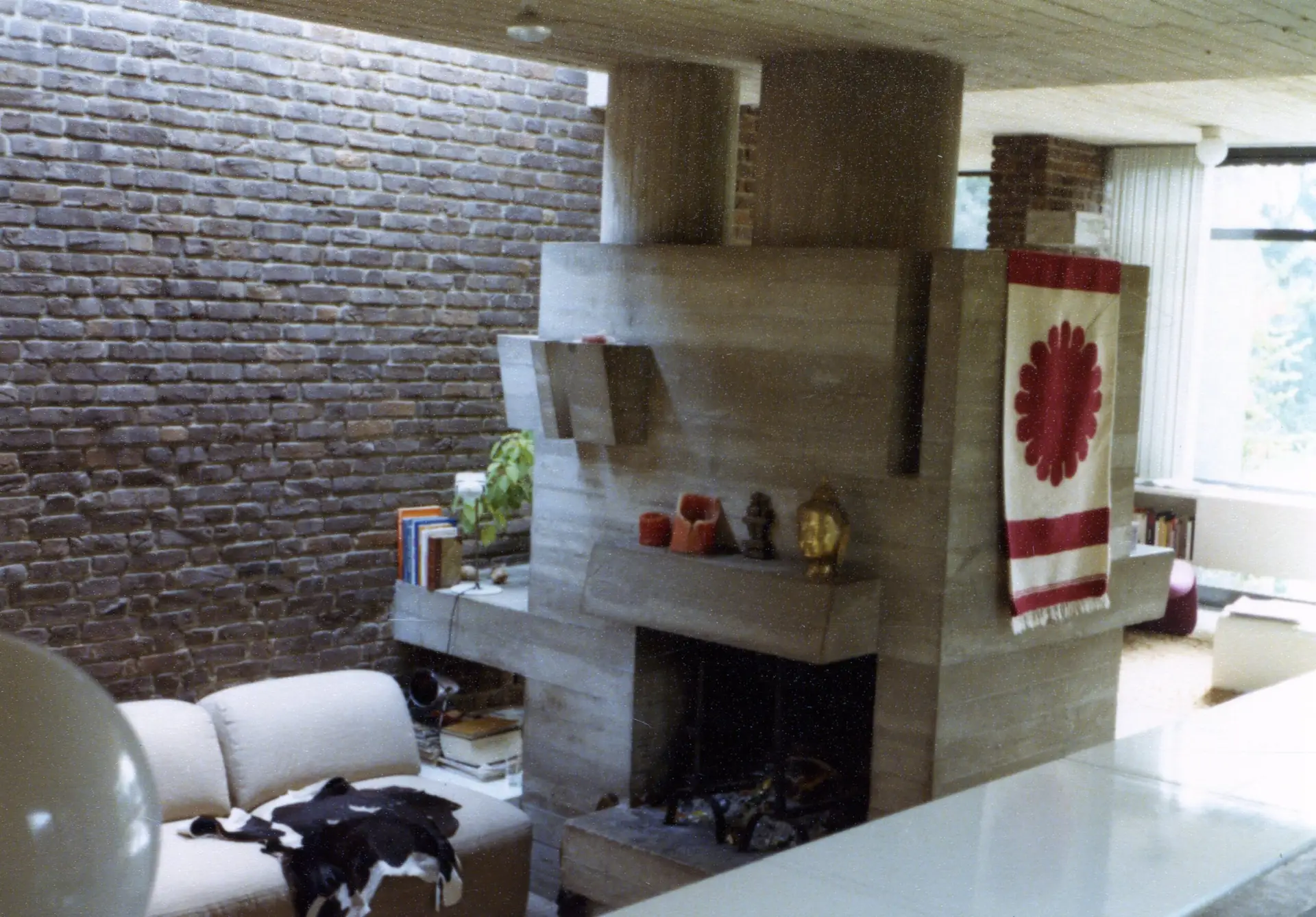
Materiality plays a distinctly expressive role in Vanhout’s work: the façades are built with over-fired manganese bricks in random bond, the concrete was carefully formed to achieve sharp imprint, and the masonry flows seamlessly from exterior to interior. Even the windows were fitted with additional steel bands in a Corbusian play of planes and lines.
The fireplace corner is a highlight: a sunken space with a massive sculptural hearth element surrounded by walls and a concrete railing, reminiscent of Le Corbusier’s idea of the home as a protective cave.
With this design, Carli and Paul immediately proved themselves masters in composing spatial experience. Light, material, scale and nature ingeniously interlock here.